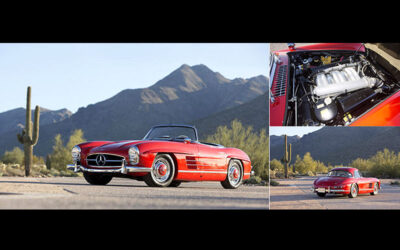
Despite the misleading name, the Mercedes-Benz 300 SLR was based neither on the famous 1954 300SL (W198) Gullwing road car, nor the earlier 1952 (W194) race car, although it bears a strong resemblance to both (including, in the coupe version, the distinctive ‘gullwing doors’). Instead, it was based on the 1954–1955 Formula 1 Mercedes-Benz W196 race car; it was Mercedes’ marketing department, considering ‘W196S’ an uninspiring name, who ordered the name ‘300 SLR’. It is generally accepted that this name references the car’s lightweight construction as ‘Sport Leicht Rennen’.
The car was designed by longtime Mercedes designer Rudolf Uhlenhaut. It was a front-mid-engined design (where the engine block is squarely behind the front axles), in order to give a more neutral front/rear weight distribution. It used a spaceframe chassis and magnesium-alloy (Elektron) bodywork, which has a specific gravity of just 1.8 (for reference, the S.G. of iron is 7.8), both of which contributed to a dry weight of just 880 kg (1,940 lb). The preceding Formula 1 car’s 8-cylinder in-line engine was used, increased in capacity from 2,496.87 cc (76.0 x 68.8 mm) to 2,981.70 cc (78.0 x 78.0 mm). This boosted output from 290 bhp (220 kW) at 8,500 rpm to about 310 horsepower (230 kW) at 7,400 rpm, depending on the intake manifold; maximum torque of 318 N·m (235 lb·ft) at 5,950 rpm (193.9 psi (1,337 kPa) BMEP). The engine was longitudinally mounted and canted at a 33-degree angle to lower its profile for aerodynamic reasons, resulting in the distinctive bonnet bulge on the passenger side of the car. The engine was also unusual in having desmodromic valve actuation instead of springs. Its war-time derived fuel injection was still a novelty then. The engine protruded some way back into cockpit, forcing drivers of the monoposto to straddle the driveshaft and clutch bellhousing with his feet to reach the pedals. To reduce crank flexing, power takeoff from the engine was at the center of the engine, via a gear, rather than at the end of the crankshaft. This was not the only oddity of the drivetrain – the car was fitted with vast inboard drum brakes which dwarfed the car’s 16″-wheels; the unusual shaft-linked brakes were originally to have been part of a planned four-wheel-drive system which never came to fruition. The rear independent suspension used a low-roll centre swing axle system, where a beam attached to each hub was mounted on the opposite side of the chassis. Thus, the beams were aligned slightly differently and crossed over in the centre line. Cornering forces did not jack the car up, as occurs with short swing axles.
The car’s fuel itself was also unusual – a high-octane fuel mixture of 65 percent low-lead gasoline and 35 percent benzene; in some races, alcohol was also used to further increase performance. As a rule, the car left the starting line with 44 gallons of fuel and more than nine gallons of oil on board, although Moss and Jenkinson began their assault on the 1955 Mille Miglia with as much as 70 gallons of fuel in the tank.[1]
At Le Mans in 1955, the 300 SLRs were also equipped with “air brakes” similar in principle to those used on aircraft – this was a large hood that hinged up behind the occupants in order to slow down the cars at the end of the fast straights. The idea for this “wind brake” came from director of motorsports Alfred Neubauer, who was looking to develop a system to reduce the wear on the huge drum brakes and tires during long-distance races such as Le Mans and Reims. Neubauer foresaw that wind resistance would slow the car especially at Le Mans, as the French track’s layout forced drivers to use the brakes hard and often to bring the car down from its maximum speed – around 180 mph (290 km/h) – to as little as 25 mph. In tests the 0.7m² (7.5 ft²) light-alloy spoiler slowed the car dramatically and improved cornering. In addition, this innovation was required as the car’s traditional drum brakes were inferior to the new disc brakes of main rival Jaguar.
The SLR also had two seats, as required for sports racing cars of the day. In some racing events a co-driver, mechanic or navigator was given a ride. In the 300 SLR’s short career, this was only during the Mille Miglia, as the 1955 Carrera Panamericana was cancelled due to the Le Mans accident. On short circuits (this includes the Targa Florio) passengers were not helpful, thus the passenger seat was covered and the passenger windshield removed to improve aerodynamics.
Nine of the W196S chassis were built.