The History of Motor Racing Videos
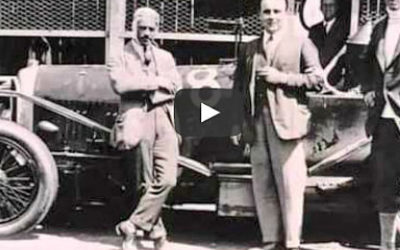
The heroic days of motor racing. A vintage documentary series of videos on a timeline that begins in 1902 and runs through 1928. Further historical text about the history of motor racing is at the bottom of this article.
VOLUME 1
Part 1
Part 2
Part 3
VOLUME 2
Part 1
Part 2
Part 3
Automobile racing began soon after the invention of the gasoline- (petrol-) fueled internal-combustion engine in the 1880s. The first organized automobile competition, a reliability test in 1894 from Paris to Rouen, Fr., a distance of about 80 km (50 mi), was won with an average speed of 16.4 kph (10.2 mph). In 1895 the first true race was held, from Paris to Bordeaux, Fr., and back, a distance of 1,178 km. The winner made an average speed of 24.15 kph. Organized automobile racing began in the United States with an 87-km race from Chicago to Evanston, Ill., and back on Thanksgiving Day in 1895. Both early races were sponsored by newspapers for promotional purposes. In Europe, town-to-town races in France, or from France to other countries, became the norm until 1903 when authorities stopped the Paris-to-Madrid race at Bordeaux because of the large number of accidents. The first closed-circuit road race, the Course de Périgueux, was run in 1898, a distance of 145 km on one lap. Such racing, governed by the Automobile Club de France (founded in 1895), came to prevail in Europe except for England, Wales, and Scotland. By 1900 racers had achieved speeds of more than 80.46 kph. Danger to spectators, racers, and livestock on roads not built for the automobile, let alone racing, ultimately caused road races to decrease in number. A notable exception was the Mille Miglia, which was not stopped until 1957.
International racing in the modern sense began after James Gordon Bennett, owner of The New York Herald, offered a trophy to be competed for annually by national automobile clubs, racing three cars each that had been built of parts made in the respective countries. The Automobile Club de France organized the first Bennett Trophy races in 1901, 1902, and 1903. The event was later held at the Circuit of Ireland (1903), the Taunus Rundstrecke in Germany (1904), and the Circuit d’Auvergne (1905). The unwillingness of French manufacturers to be limited to three cars led to their boycott of the Bennett Trophy Race in 1906 and the establishment of the first French Grand Prix Race at Le Mans in that year, the cars being raced by manufacturers’ teams. The first Targa Florio was run in Sicily the same year and thereafter except during wartime at distances varying from 72 to 1,049 km.
William K. Vanderbilt, the New York sportsman, established a trophy raced for on Long Island from 1904 through 1909 (except for 1907) at distances ranging from 450 to 482 km. Thereafter the race was run at Savannah, Ga.; Milwaukee; Santa Monica, Calif.; and San Francisco until its discontinuance in 1916. Later Vanderbilt Cup races were run in 1936 and 1937 at Roosevelt Raceway, Long Island, New York.
In early racing, in both Europe and the United States, competing race cars were usually prototypes of the following year’s models. After World War I, racing became too specialized for the use of production cars, though occasionally high-performance touring cars were stripped of their bodies and fitted with special seats, fuel tanks, and tires for racing. Still later stock-car racing in 1939 started with standard models modified for racing.