Get the old paint off!
 Getting the old paint off cars is a skill. My friend Steve and I were sitting on the front porch one summer day in 1962 when Terry Brooks drove by in his ’51 Chevy fastback. I was astounded. When he’d bought it a few weeks earlier, it had been dingy green with brown primer spots. Now, with shiny new orange enamel paint, it looked beautiful. What a tremendous difference that paint job made! In just a few weeks, Terry had transformed a faded old relic into a thing of beauty. More than any other aspect of a car, paint enhances or detracts from its appearance and value. This article and one to follow will de-mystify the painting process and provide you with knowledge that will prove useful whether you decide to attempt paint work yourself or hire a professional. Your first step is to analyze the condition of your car’s painted surface. Dull finishes can often be restored to brilliance with polishes and waxes. At least clean your car and take a good look at it. Problems such as flaking, cracking, crazing, peeling, and pinholes are easy to spot but can’t be fixed without removing the old finish. If your car has already been painted several times, strip off the old finishes and start from bare metal.
Paint Removal Choices
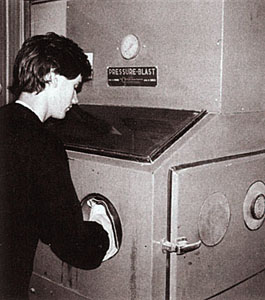 How do you remove old paint, primers, and fillers? Several methods include sandblasting, media blasting, chemical removers (hot tanks), hand stripping, power sanding, and grinding.
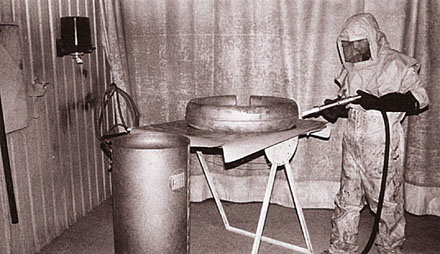
Sandblasting is a quick, effective, and economical way to strip a painted metal surface. Sandblasted metal also provides an excellent surface for adherence of primers and fillers.
Still, sandblasting has significant negative aspects. To avoid distorting and stretching the metal, an operator must be thoroughly experienced with sheet metal. I restored a 1955 300Sc that, in a previous shop, had its hood sandblasted. It took me days to shrink the stretched areas back to the correct contours. Another snag with sandblasting is work hardening of the sheet metal surface. Sand grains hitting sheet metal have the same effect as striking the panel with thousands of tiny hammers, making the panel stiffer.
In my opinion, sandblasting is unacceptable when a car is still assembled because sand and dust migrate to every part of the car, getting into bearings and mechanical components as well as every nook and cranny. Years later you’ll see sand fall out of hidden crevices. Sand grit quickly destroys machined surfaces such as bearings and bushings. Even if the parts are masked and sealed, grit will get in. I learned this the hard way—early in my career I ruined a VW convertible using this method.
Sandblasting is good for removing rust and paint from heavy metal parts such as castings and housings. It works great on things like bumper brackets or a totally stripped chassis. Due to the possibility of warpage, it should never be used on aluminum.
Media Blasting
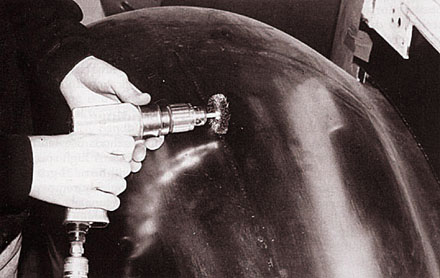
Removing paint by media blasting is increasingly popular. It’s similar to sandblasting with an important exception. Instead of sand, it uses another media—hard plastic crushed to the consistency of sand. The same material used for common plastic buttons, it is hard enough to remove paint and primers yet has no effect on the metal surface beneath. I saw a demonstration on a die-cast metal part that had been chrome-plated then partially painted. Although the chrome was unprotected, the media blast removed the paint without damaging the surface. With this method you’ll still have dust everywhere on an assembled car, but you won’t have sand grit to damage mechanical parts.
The main drawback is that this process doesn’t remove rust. The media isn’t hard enough to dry out rust. Several years ago I worked on the first production 300SL Roadster. For this special car, we needed the least destructive method to remove its paint. The media did an excellent job without affecting the metal underneath. Still, surface rust in the lower panels and wheel housings had to be removed with a small grinder and wire brushes – very time consuming. Media blasting is also not very good at removing plastic body fillers, which are best removed by a grinder. Media blasting is somewhat more expensive than sandblasting due to the higher cost of the media.
Chemical Removal
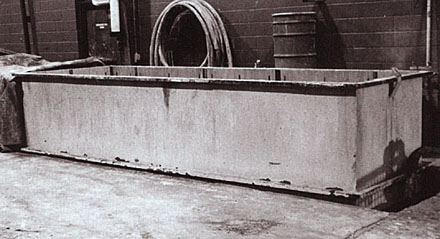
There are several methods of chemical paint removal. Hot tank stripping, or dipping, is an efficient way to strip bodies and parts. Dipping involves immersing the body or part in a tank of hot caustic solution. The body is submerged for several hours until paint and undercoating have softened enough that they can be washed off with a strong stream of water. The body is returned clean and de-rusted (the caustic also attacks rust, effectively removing it), ready to be washed with a metal conditioner and primed. The negative aspect of this process is that it can’t be used to strip aluminum. Visiting Harrah’s restoration shop in Sparks, Nevada, I arrived just as a painter was removing the remnants of a 1928 RollsRoyce hood from their hot tank. Too late, they discovered it was aluminum. The hood was 90-percent eaten by the caustic solution.
The 190SL and 300SL Roadster bodies, for example, can’t be hot stripped due to their aluminum cowl sections. The caustic solution will also oxidize the surface of lead filler used by the factory to fit panels and edges and fill imperfections and panel seams. Vintage Mercedes-Benz cars have a lot of lead in their bodies. Oxidation makes a leaded surface chalky and brittle, necessitating its removal and replacement. Re-leading is time-consuming and expensive. To limit costs, many restorers elect to replace lead with plastic fillers.
A caustic residue, trapped in nooks and crannies not thoroughly flushed with clean water, will later cause failure of paint in affected areas.
Hand Stripping
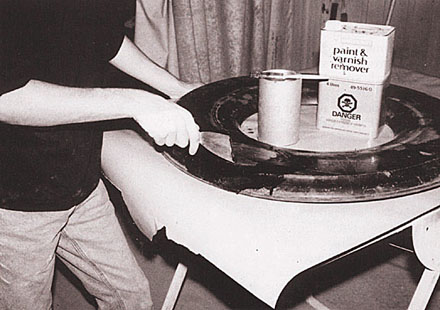
Another option involving chemicals is hand stripping. A chemical paint remover, bought in quart or gallon cans, is brushed in liquid paste form onto a painted surface. The paste is allowed to work a few minutes, then a scraper or putty knife is used to remove the softened paint and undercoating. Several applications are usually necessary to take off al1 the paint. Occasionally the bottom primer coats seem liffle affected by the stripper and must be removed by sanding or grinding. Hand stripping is a nasty business. The fumes are noxious, and the chemicals can burn unprotected skin. Because it removes paint without damaging the panel, hand stripping works well on aluminum, but it is less advantageous where there is a lot of paint or filler on the panel. The stripper is expensive and can require numerous applications.
Power Sanding
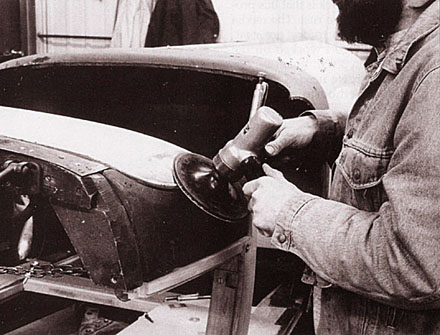
Our final methods use sandpaper or grinding discs. A high-speed 7-in body grinder with 16 or 24 grit grinding discs will quickly remove paint and fillers. Unfortunately it removes metal, too. If an operator isn’t careful, deep scratches and gouges can occur. Sometimes excess heat caused by friction can warp a panel. Never use a grinder to strip aluminum panels.
Grinding is best for removing small areas of paint that haven’t responded to other methods. Use care when grinding near chrome or glass; a grinder throws off sharp hot particles at high speeds that can pit unprotected areas.
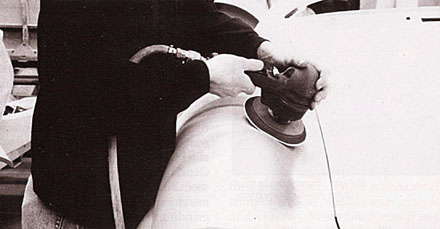
Power sanding is a paint removal method with few drawbacks. Dual action (DA) sanders combine orbital and random motions, quickly grinding away paint without the rough action and heat of a body grinder. Relatively soft paint may gum or load up DA sandpaper quickly, but stripping with DA is appropriate on any painted surface. It is only limited by where the DA can reach with its round, flat disc. Probably the cheapest and safest method if you attempt the stripping yourself, it requires only a DA sander, minimal skill, and a large compressor (five hp or more).
Metal Conditioning
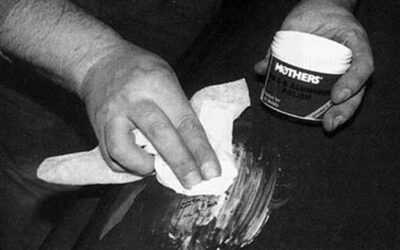
After a surface has been completely stripped of paint, primer, and plastic fillers, the next step is metal conditioning. On bare metal, rust forms quickly. It is important to clean off this surface rust and be sure the surface is chemically clean. To etch the surface for better paint adhesion, use metal conditioner. Metal prep for steel, or aluma prep for aluminum, is applied with a clean rag and immediately rinsed off with cold water, then the surface is dried. The process is the same for aluminum or steel. The metal should then be sprayed with a light coat of primer to prevent rust. Improper use of metal conditioner can cause paint failure later.
Next time we’ll discuss painting, including undercoatings, block sanding, guide coats, sealers, top color coats, color sanding, compounding, and final finishing.
Thanks to RM Auto Restorations in Chatham, Ontario, for help with photography.