There are three principals in a restoration: car, restorer and client. As a client, you’ve spent time choosing the right car, waiting a long time to restore your favorite car, and the restorer’s work represents a significant investment. Here are some suggestions to help you keep the job smooth, exciting and under control.
Restoration begins before a craftsman ever touches the car. If you already have a car, is it the right one to restore? And if you’re looking for a car to restore, do you want one that needs only partial restoration or are you willing to go all out to take a very special model from basket case to show quality?
Choose a car that is complete. Duplicating lost or badly damaged parts is slow and costly. It’s usually smarter to pay more for a complete car. Of course, if the car is genuinely rare, you may have to settle for what you can get.
 Avoid basket cases. There’s always something missing. It’s impossible, even for an expert, to tell if all the parts are there. You can catalog the major pieces and make a fair assessment of completeness, but it’s hard to identify all of the cables, brackets, hardware, etc. And when you’re assembling the vehicle, it’s hard to tell exactly where everything goes unless you disassembled the car carefully. If the car is a common model, you can look at another, but if the car is rare, discovering what’s missing, finding it and installing it properly requires intensive, time-consuming effort. On a fully assembled car, it’s easy to see that a trim molding is gone or that the clutch linkage is missing.
Pick A Good Car
Assessing a car’s condition can be difficult. When a car is freshly painted, be suspicious.It’s easy to paint over rust and damage that has been poorly repaired with plastic fillers. Beauty may be literally only skin deep. As time passes, problems caused by poor repair or quick fixes will show up. Look for a car that’s not freshly painted.
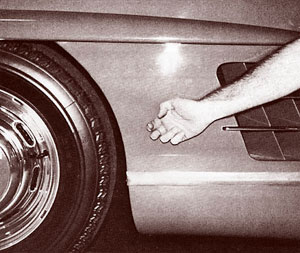
Tap a few panels with your knuckles; dull or dead sounds can indicate excessive build-up of plastic fillers. Check the edges of the doors and trunk lid; thick or uneven edges may indicate excessive material from prior repairs. Cracking or checking of the paint usually indicates more serious problems beneath it.
If possible, get the car up on a lift to check the undercarriage for rust and accident damage. Rust is the most difficult and expensive damage to cure properly. It must be cut out and removed completely, then repair panels have to be fabricated and installed. Rust is usually found where water can collect, such as inside the trunk wells and in lower fender and door areas Careful inspection of inner panels— inside the hood, trunk, doors, door jambs, etc.—will usually reveal major rust or prior collision damage. Inspect the car in daylight or in a well-lit area, never at night, in a dim garage or in the rain, where you can’t see the important details.
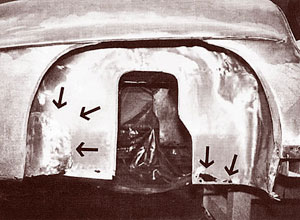
If the car is rusty, remember that most post-war models were built in sufficient numbers that if you look, you can find a better car to start with. Restoring a rusty car usually costs much more than the car is worth. Instead of pouring time and money into a losing cause, find a better car to restore. And don’t make the mistake of getting emotionally involved with a car. Trying to restore your sweetheart can lead to needless financial and emotional ruin. If that happens, you’ll wind up hating the car.
Why And How?
Before you begin your restoration, have a clear idea of your goal. Do you want a nice Sunday driver? Do you intend to show the car? If so, will you feel relaxed about showing it, or will you want a national show winner? It’s important to make a clear decision about these alternatives so that you can choose an appropriate restorer and give him the proper direction.
It can cost you twice as much to make a show car as a Sunday driver, and twice as much again if you want a 100-point show car. Once you’ve started in one direction, it can be costly to change goals.
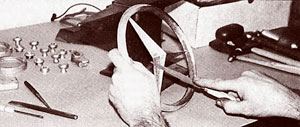 There are several basic approaches to accomplishing your restoration. The rarest approach is to do all work yourself, but a first class restoration requires time and talent beyond what most of us possess, not to mention tools and workplace. There’s value in hiring a professional to do a professional job, just as you see a doctor or a lawyer. If you are a professional yourself, your time may be better invested in making money to pay for the restoration than in actually doing it yourself. On the other hand, if you have the time, talent and tools to do a good job, there’s great satisfaction to be gained. But if things go wrong, there’s at least equal frustration. Diving into a challenging restoration without proper training, skills and experience usually only leads to frustration.
Another approach is for you to assume the role of general contractor, possibly doing the disassembly and assembly yourself and sub-letting the critical phases, such as body and paintwork, to a qualified shop. You coordinate and monitor the work. Many people choose this method of participating in the restoration, which can save money.
 The disadvantage is that it requires a thorough understanding of the car and the restoration process, and it can also be time consuming. Working with subcontractors can be difficult if the coordinator is not an expert. Parts may be lost, jobs overlooked, and scheduling is critical. As an example, maybe the chrome is sent for re-plating before fitting it to thebody afterbody work is completed. The body and chrome can look beautiful, but if they’re done in separate shops, it’s likely they won’t fit well when they come back together.
If you have the necessary background and enjoy the hands-on approach, this subcontractor method is a viable alternative. But if you don’t want to handle the restoration yourself, you’ll have to find a competent shop (or shops) and deal with them.
Repair Or Restoration?
It’s important to differentiate between repair shops and restoration shops. Ninety-nine percent of today’s repair shops are oriented toward fixing modern cars, with the emphasis on getting them in and out quickly. Components are replaced rather than repaired. A restorer, on the other hand, must be patient, organized, artistic and knowledgeable, in addition to being a specialist in painstaking craft techniques nearly extinct today.
Repair shops are tied to the flat rate system, which gives a mechanic a specific time to repair a specific component. For example, the flat rate for removal and replacement of a bumper on a certain model might be specified at 0.8 hour. But this doesn’t allow for individual problems, and the mechanic will be tempted to take shortcuts in order to make money. The flat rate system and restoration require two different mentalities and personalities.
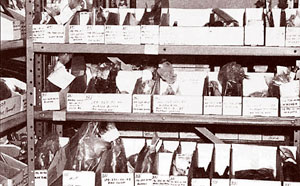
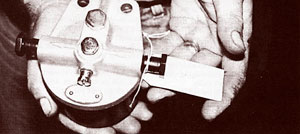
Another crucial consideration in choosing a shop is organization. A serious restoration involves literally thousands of parts and pieces. Keeping these properly organized requires careful cataloging. We recommend photographing each part of the car before disassembly, then tagging and grouping all parts as they are taken off the car. For example, all electrical components are grouped, as are engine parts. The windshield wiper motor, linkages, arms and blades are in one group, while the instruments and gauges are in another. Each piece is individually tagged, catalogued and inspected. It is then added to a master parts list according to what it is and its condition, unrestored or processed. The part can then be disassembled and routed for cleaning, refurbishing and reassembly or for sublet operations such as plating.
Various processes and parts need to mesh in logical order. For instance, plating and other sublet operations must be done early enough so that you have all the parts ready for assembly. Anything which might hold up the process should be identified and dealt with early.
A major restoration is like the weaving of a tapestry. A logical sequence of events leads to a finished product. Some restoration shops find that doing as much of the work in-house yields the most satisfactory results. First, you have better control of schedules and quality. And some operations, such as body, paint and interior work, benefit from close cooperation. For instance, the body man can repair interior pieces such as seat reinforcements and tracks. The mechanic may need the body man to close some firewall holes, but if the body man isn’t close by, he may just ignore the problem because of the hassles of bringing in an outside body man.
 In choosing a restorer, address the following topics, not necessarily in order:
- Personality: Can you work with this person? Restoration can last a long time, and problems arise that require discussion and decisions. Can you get along with this person?
- Management Skills: Is the shoporganized? Does the restorer bill regularly? Do the employees work well together?
- Neatness: Is the shop clean? People who don’t keep their work environment neat often approach their work the same way.
- Craftsmanship: Good work speaks for itself. Ask for references, and look at some of the shop’s past projects.
Dealing With Dollars
Financial management of a restoration is a primary concern for you and your restorer. Shops usually handle payment in one of two ways. One is to bid the job for a fixed price, with a large down payment, say 33 percent, to start. A further third is due about halfway to completion, with the final third due on delivery.
This arrangement gives you a fixed price, but it’s generally better suited to small jobs such as simply having the car painted or the interior done. On larger, more complex restorations, this method is less successful. Quoting an accurate fixed price is very difficult and fraught with risks on a major job because when the car is disassembled, serious problems may be found that weren’t evident before. If the restorer is limited by a fixed price, he’s then faced with either losing money or taking shortcuts.
A restorer can only work on a fixed bid basis if he makes it high enough to cover unknown contingencies, and then you lose. Either way, one or both of you lose. Another problem is the large progress payments, which put the restorer in a feast or famine situation. Sometimes the price remains firm, but the car is poorly done or not completed at all.
The best approach is for the restorer to charge for time and materials. An experienced restorer can still give you an estimate, but it is understood that the actual cost will be based on the actual time and materials involved. There’s no incentive for the restorer to shortcut, and you pay only the actual cost.
Good professional shops bill regularly, perhaps weekly or monthly. This requires more billing work, but it keeps the client in touch with what’s going on, and he’s less likely to be hit with huge financial surprises.
Experience shows that restoration expenses are usually divided fairly evenly between the areas of disassembly, assembly, parts, mechanical work, upholstery, body and paint work. This is useful as a rough guide for budgeting and monitoring the cost of your restoration.
Restoration can mean anything from a shiny new coat of paint to the complete remanufacture of a vehicle. There’s no simple definition, industry standards or government regulations. While many auto body shops occasionally get involved in a restoration, truly professional restorers are few and far between.